Pololu 3.3V Step-Up/Down Voltage Regulator with Adjustable Low-Voltage Cut-off
The Pololu S9V11F3S5CMA switching step-up/step-down regulator efficiently produces a fixed 3.3V (default) or 5V (selectable) output whether it is higher or lower than the input voltage which can range from 2V to 16V (minimum start-up voltage is 3V, but it operates to 2V after that).
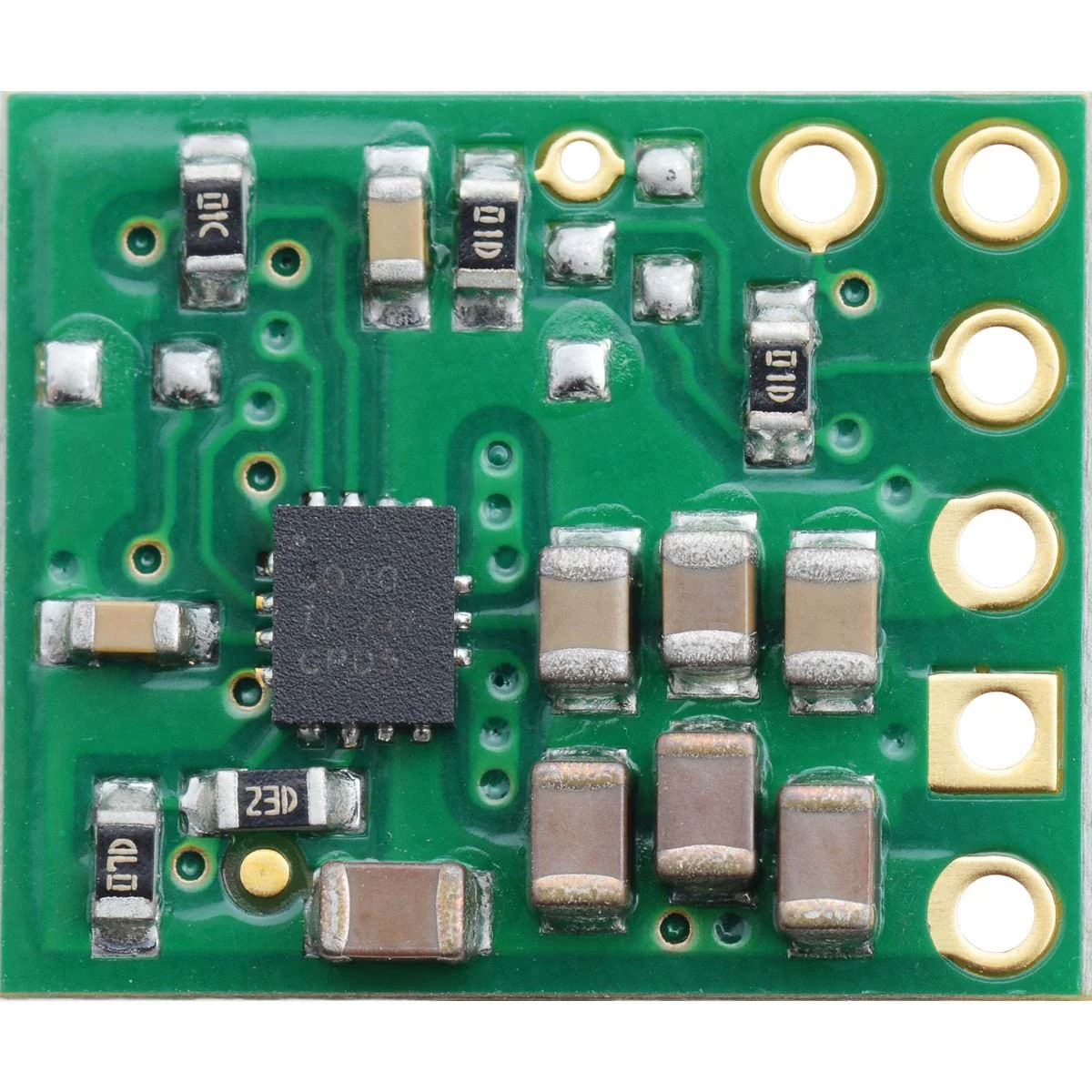
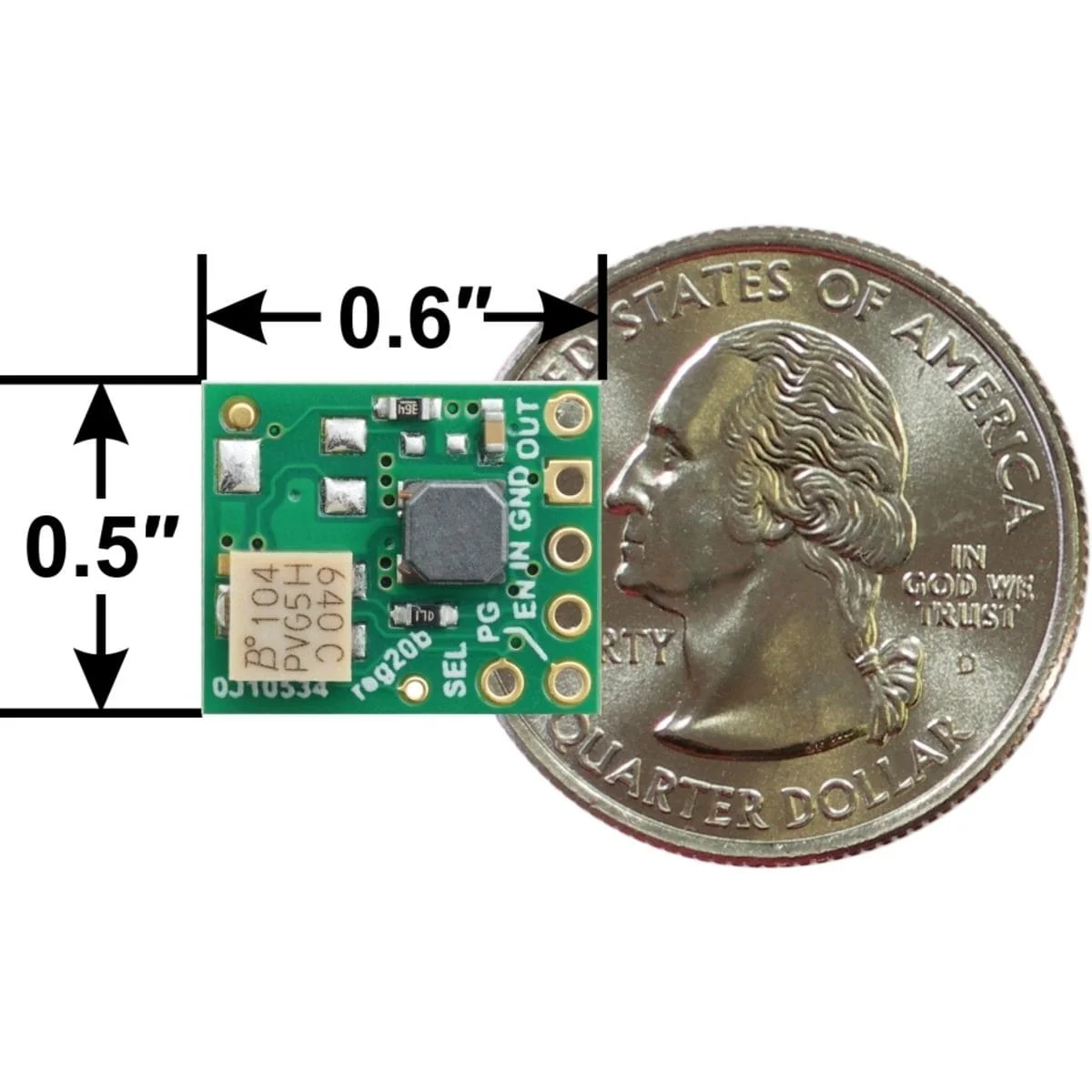
The regulator also has a precision-adjustable low-voltage cutoff with hysteresis that can be used to prevent battery over-discharge. The compact (12.7 × 15.3 × 6.4 mm) module can supply a typical output current of up to 1.5A when the input voltage is close to the output voltage.
Note: During normal operation, this product can get hot enough to burn you. Take care when handling this product or other components connected to it.
The S9V11x Family
The S9V11x family of efficient switching regulators (also called switched-mode power supplies (SMPS) or DC-to-DC converters) use a buck-boost topology to convert both higher and lower input voltages to a regulated output voltage.
They take input voltages from 2 V to 16 V and increase or decrease them as necessary, offering a typical efficiency of over 85% and a typical output current of up to 1.5 A. The flexibility in input voltage offered by this family of regulators is especially well-suited for battery-powered applications in which the battery voltage begins above the regulated voltage and drops below as the battery discharges. Without the typical restriction on the battery voltage staying above the required voltage throughout its life, new battery packs and form factors can be considered.
The different members of this family offer different output voltage options, from fixed voltages with selectable alternatives to adjustable voltages that can be set anywhere between 2.5 V and 9 V using a precision 12-turn potentiometer. Some versions also have an adjustable low-voltage cutoff that can be set anywhere in the 2 V to 16 V output voltage range and used to prevent your battery from over-discharging. This is particularly useful for battery chemistries that can be damaged when over-discharged, including Li-ion and LiPo.
These regulators have short-circuit protection, and thermal shutdown prevents damage from overheating; they do not have reverse-voltage protection. Note that the startup current is limited to approximately 700 mA until the output voltage reaches the nominal voltage; after startup, the available current is a function of the input voltage (see the Typical efficiency and output current section below).
Features
- Input voltage: 2 V to 16 V (note: this regulator requires 3 V to start, but it can operate down to 2 V after startup)
- Fixed 3.3V output with +5/-3% accuracy (can be changed to 5 V using the SEL pin)
- Typical maximum continuous output current: 1.5 A (when input voltage is close to the output; the Typical efficiency and output current section below shows how the achievable continuous output current depends on the input and output voltages)
- Precision-adjustable low-voltage cutoff with hysteresis can be used to protect batteries from over-discharging (quiescent current is approximately 10 µA per volt on VIN when the regulator is disabled)
- Power-good indicator can be used to tell when the regulator has reached and is maintaining its target output voltage
- Power-saving feature maintains high efficiency at low currents (quiescent current is less than 1 mA while enabled)
- Integrated over-temperature and short-circuit protection
- Small size: 12.7 × 15.3 × 6.4 mm
Specifications
| Minimum operating voltage | 2 V |
| Maximum operating voltage | 16 V |
| Maximum output current | 1.5 A |
| Output voltage | 3.3 V |
| Reverse voltage protection? | N |
| Maximum quiescent current | 1 mA |
| Low-voltage cutoff | Adjustable |
| Size | 12.7×15.3×6.4mm |
| Weight | 0.8g |
Included hardware
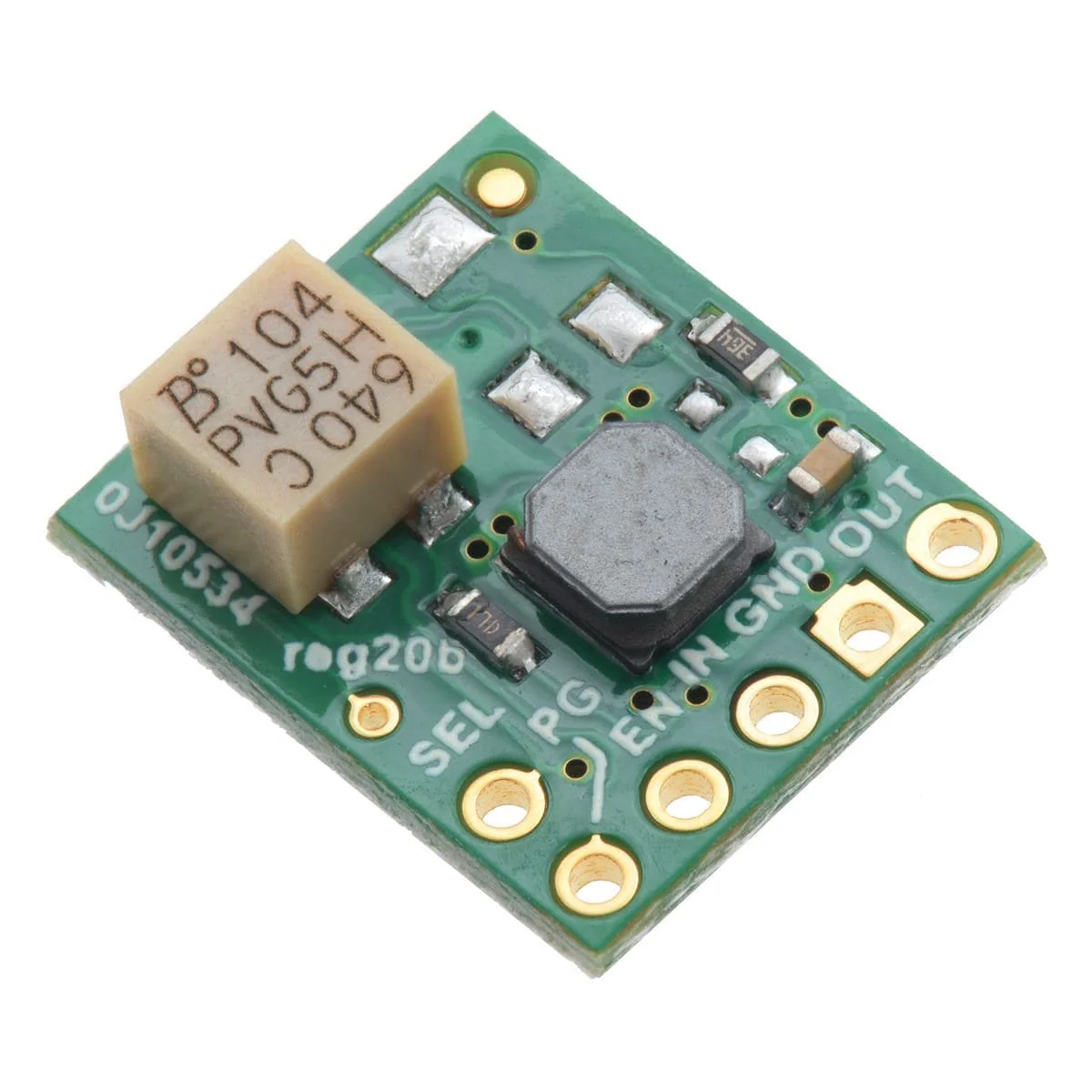
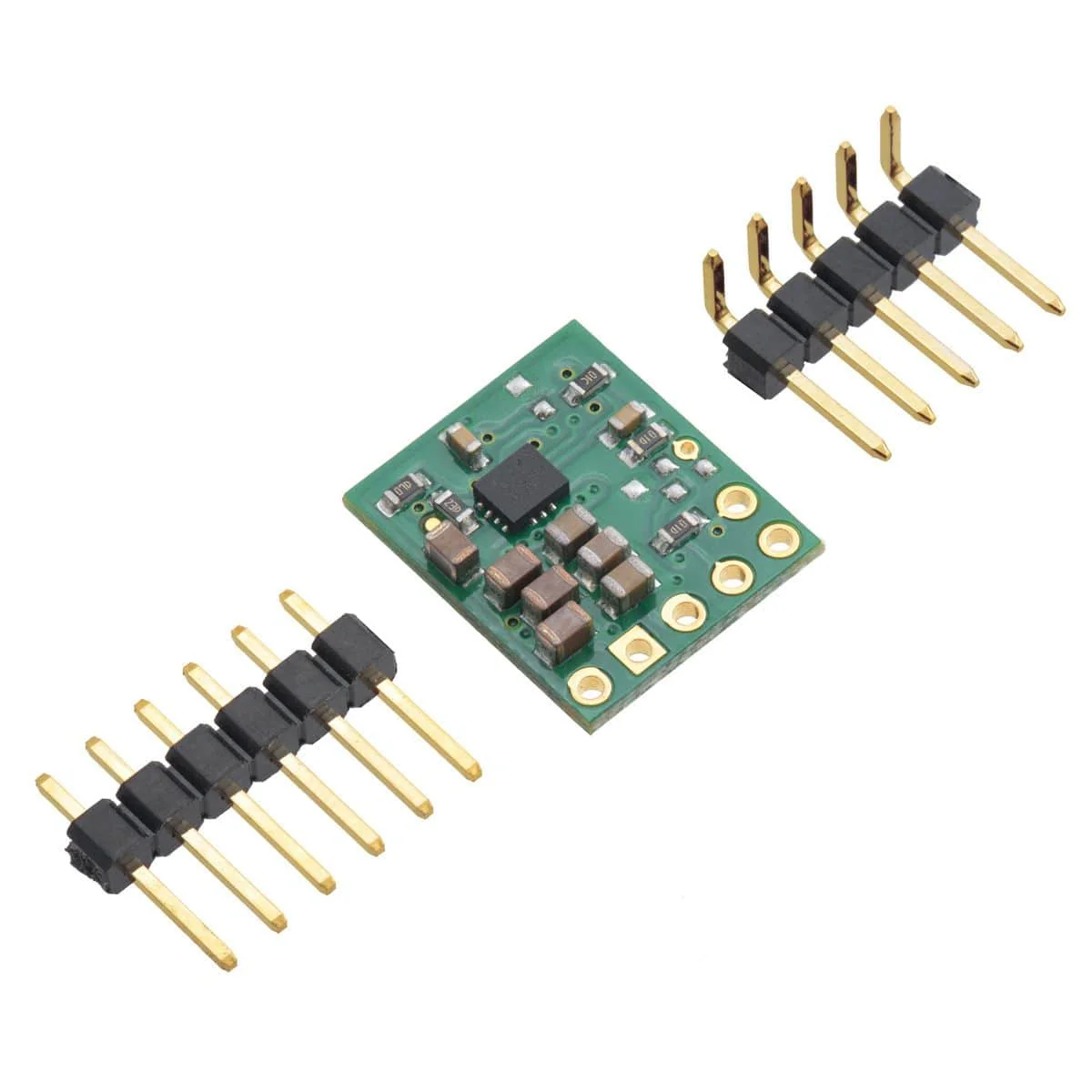
The five main through-holes are arranged with a 0.1″ spacing along the edge of the board for compatibility with standard solderless breadboards, perfboards and connectors that use a 0.1″ grid.
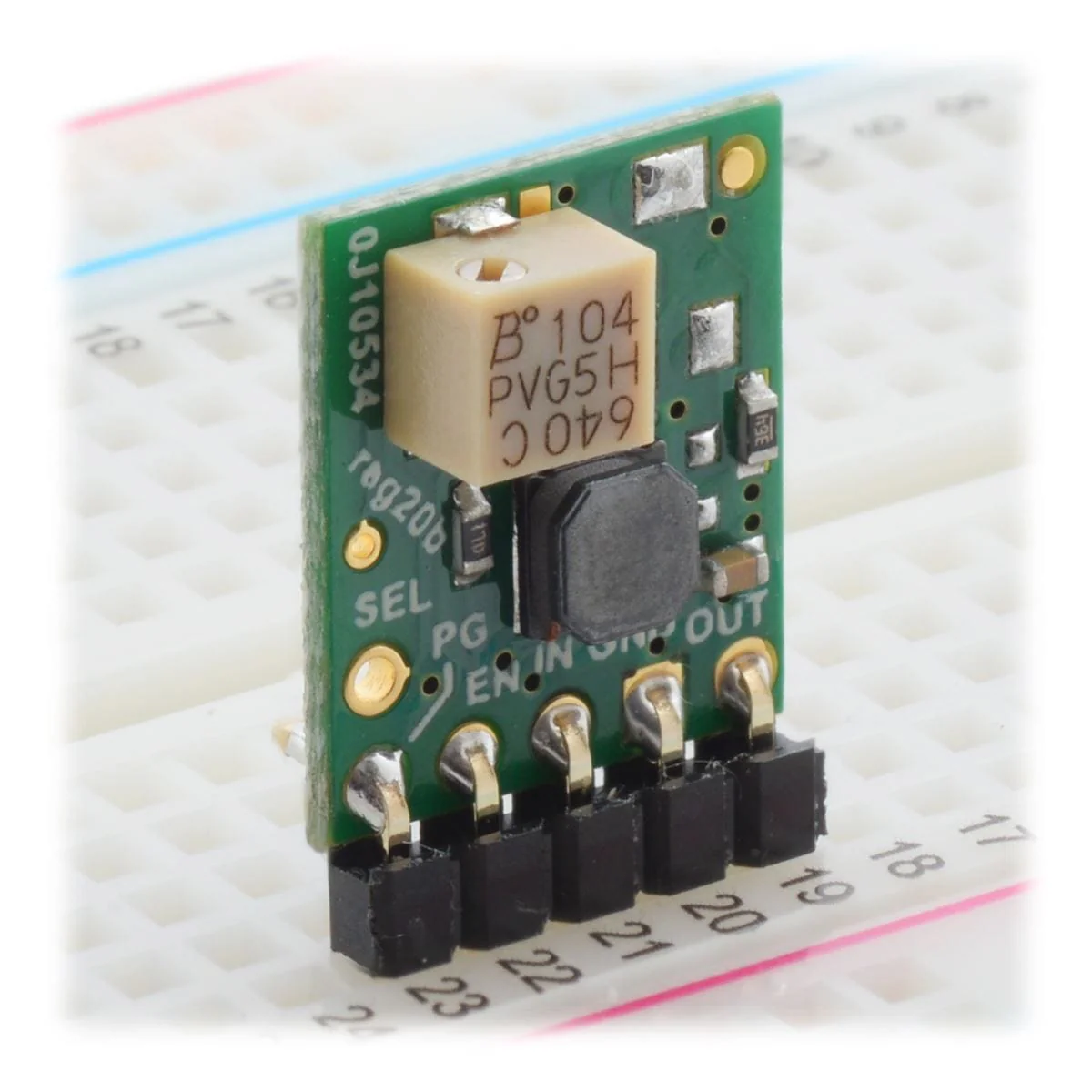
You can solder wires directly to the board or solder in pieces of the included breakaway 6×1 straight male header strip or the 5×1 right-angle male header strip as desired. The additional straight male header pin can be soldered into the SEL input, though this could prevent the regulator from being used in a breadboard.
Resources
- Dimension Diagram
- 3D Model (STEP)
- DXF Drill Guild
Connections
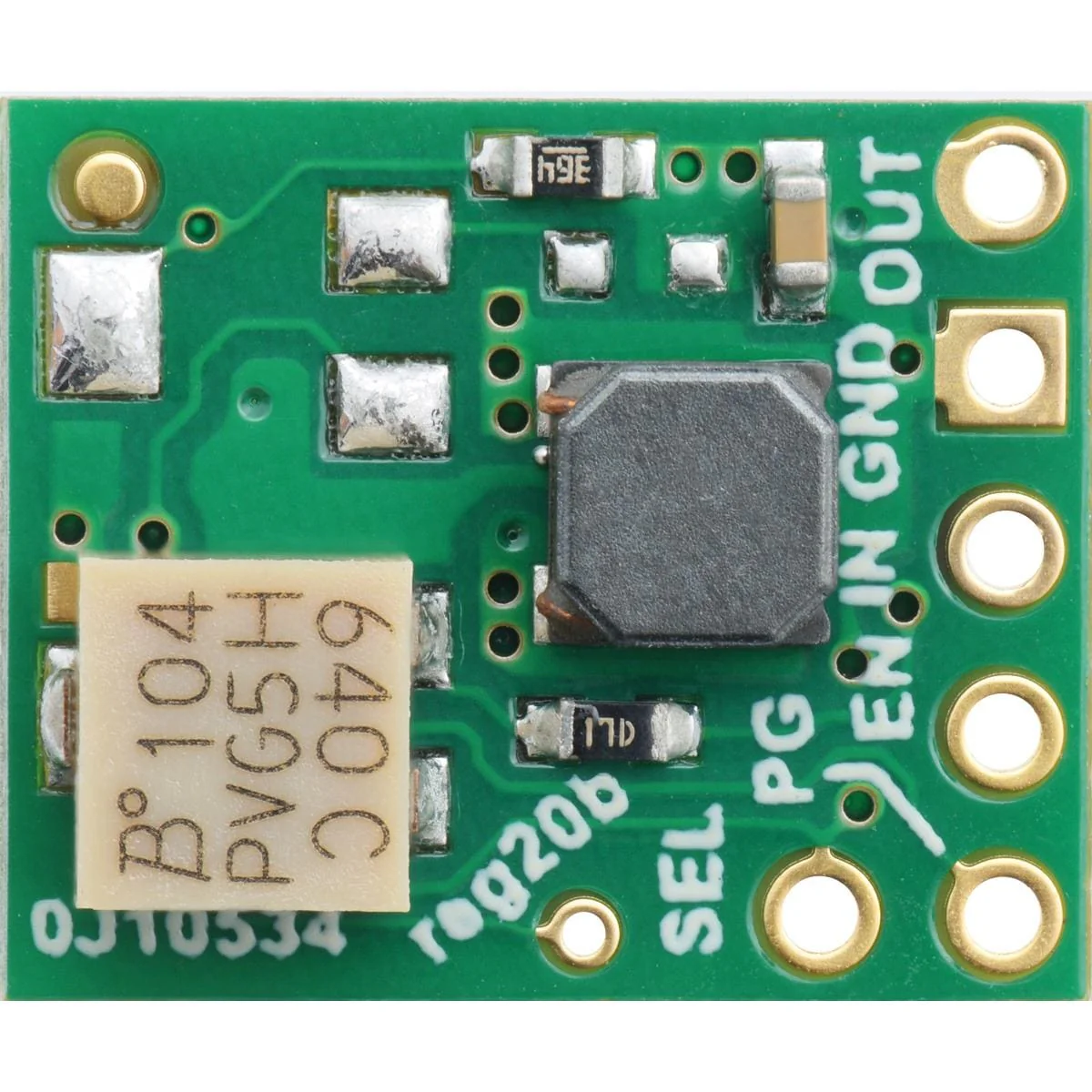
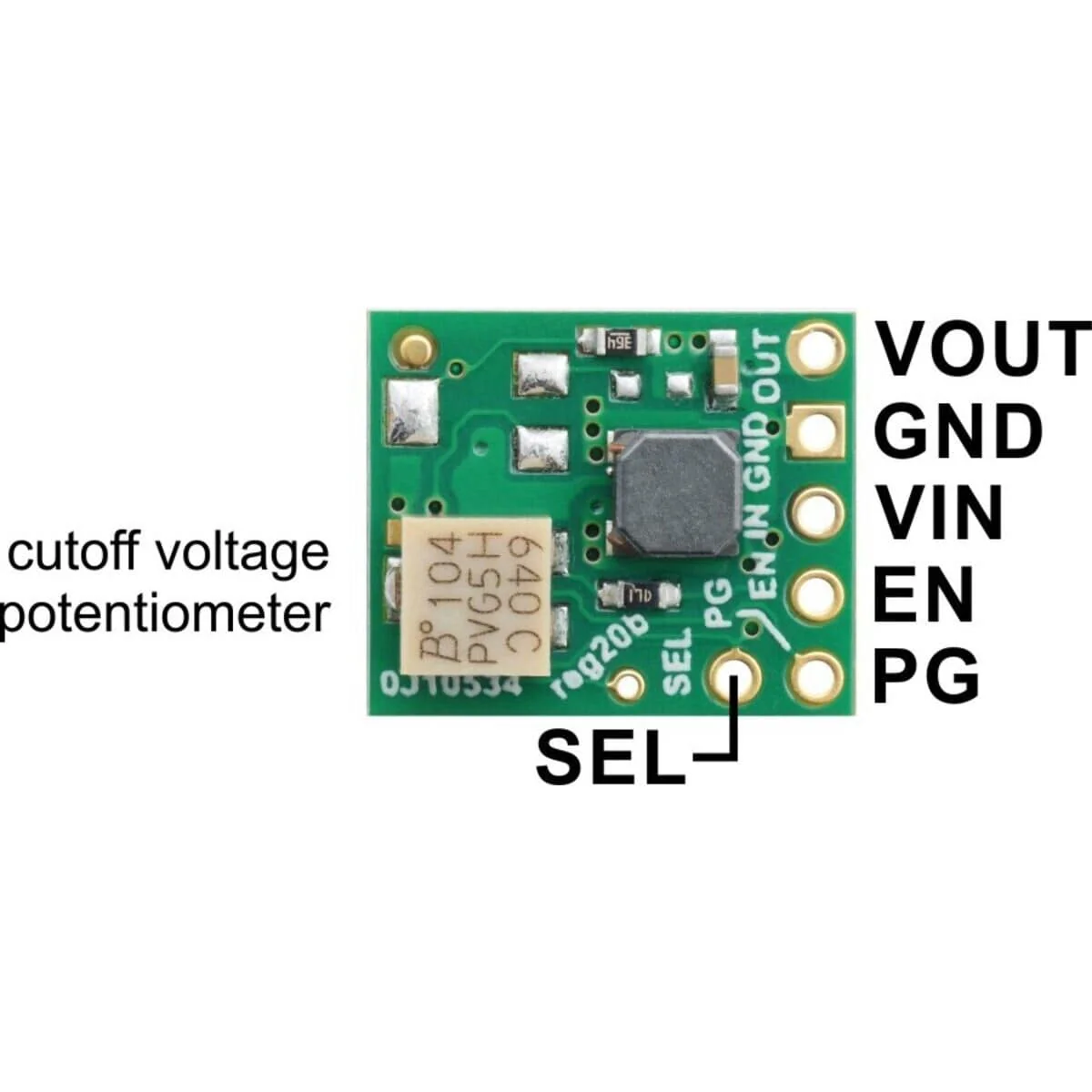
The step-up/step-down regulator has five main connections all located along the same edge of the board: the output voltage (OUT), ground (GND), the input voltage (IN), an enable input (EN), and a power good indicator (PG). A sixth pin, SEL, can optionally be used to change the output voltage from 3.3 V to 5 V.
The output voltage, VOUT, defaults to 3.3 V but can be changed to 5 V with output voltage selection pin whose operation is described below.
The input voltage, VIN, should be between 3 V and 16 V when the regulator is first powered. After it is running, it can continue operating down to 2 V. Lower inputs can shut down the voltage regulator; higher inputs can destroy the regulator, so you should ensure that noise on your input is not excessive, and you should be wary of destructive LC spikes (see below for more information).
The regulator features an enable pin, EN, that can be used as a precision low-voltage cutoff thanks to its tight activation and deactivation thresholds (voltages below 0.7 V trigger a low-power sleep state, and voltages above 0.8 V re-enable the regulator). On this regulator version, EN is connected to VIN through a 12-turn potentiometer to provide a user-adjustable cutoff threshold, which is useful for battery-powered applications where draining the battery below a particular voltage threshold could permanently damage it. The quiescent current draw in this sleep mode is dominated by the current in the resistor network from ENABLE to VIN, which is approximately 7 µA per volt on VIN (e.g. approximately 20 µA with 3 V in). See the Setting the cutoff voltage section below for details on how to use the built-in potentiometer to set the cutoff threshold.
The “power good” indicator, PG, is an open-drain output that goes low when the regulator’s output falls below around 90% of the nominal voltage, including when the enable pin is held low. The power good indicator is held low until the output reaches 95% of the nominal voltage when it is powering up or coming out of low-power mode. Otherwise, the PG pin is high-impedance, so an external pull-up resistor is required to use this pin.
The select input, SEL, can be driven above 1.1 V (up to 16 V) to change the output voltage of the regulator to 5 V. Driving the pin low or leaving it disconnected sets the output to 3.3 V. To permanently set the output to 5 V, you can solder a piece of wire between SEL and the unpopulated pad next to it, which is pulled up to VIN.
Setting the cutoff voltage
The low VIN cutoff voltage of the regulator is controlled by adjusting the voltage at the EN pin with a 12-turn precision potentiometer.
When the voltage on the EN pin falls below 0.7 V the regulator is put in a low-power sleep state and when the voltage on EN rises back above 0.8 V the regulator is turned back on. Turning the potentiometer clockwise increases the low-voltage cutoff. The cutoff voltage can be set by measuring the voltage on the VIN and EN pins and using the potentiometer to adjust the voltage on EN according to the following equation:

For example, if you connect VIN to a battery that currently measures 3.7 V and you want to set the cutoff voltage to 3.0 V, the equation becomes:

Solving for EN yields approximately 0.86 V, so you should turn the potentiometer until you measure that voltage on the EN pin.
Note that the regulator’s low VIN cutoff behaviour includes hysteresis: the regulator turns off when EN falls below 0.7 V, but it does not turn back on until EN rises above 0.8 V. Therefore, VIN must reach about 114% of the cutoff voltage before the regulator will re-enable its output (about 3.43 V in this example).
Typical efficiency and output current
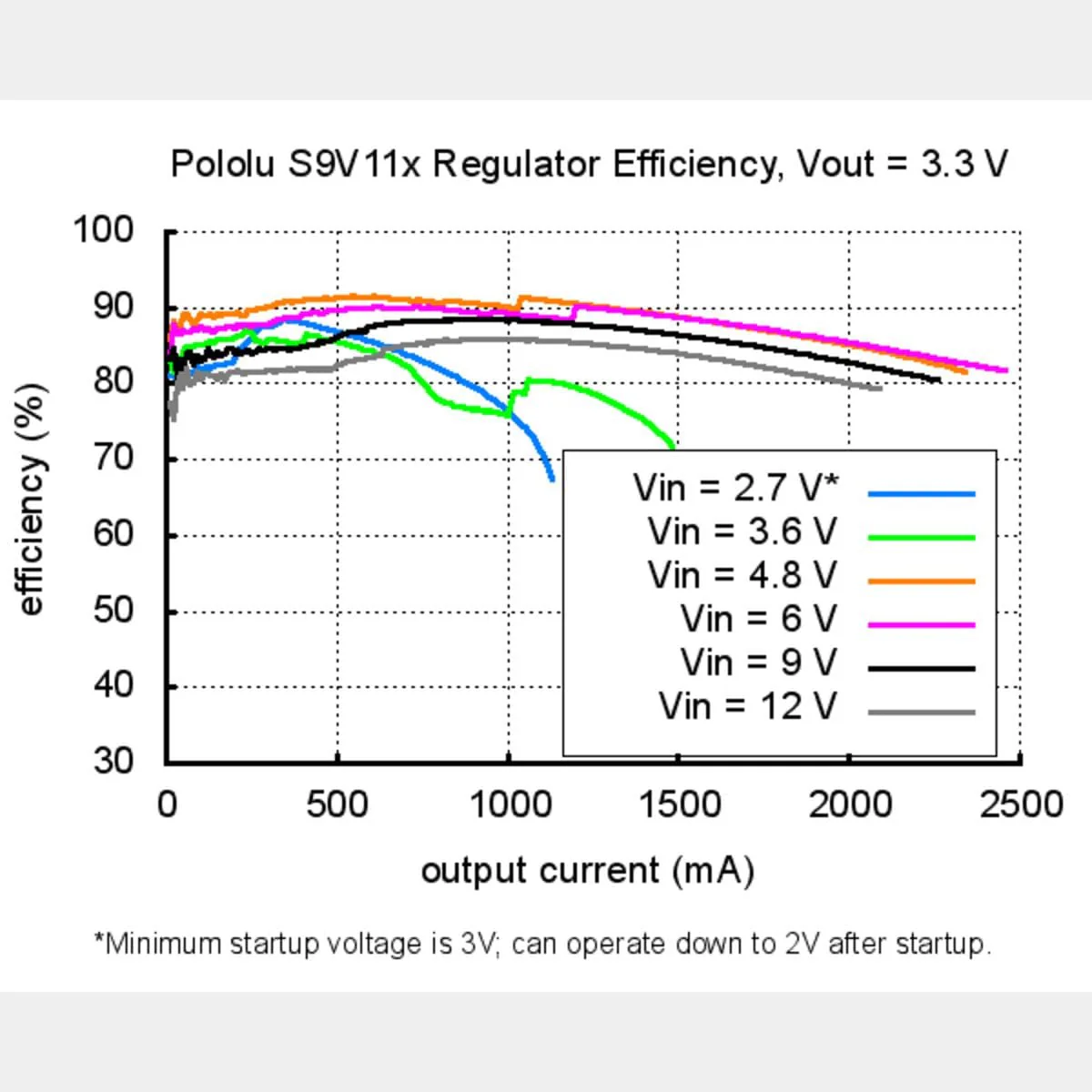
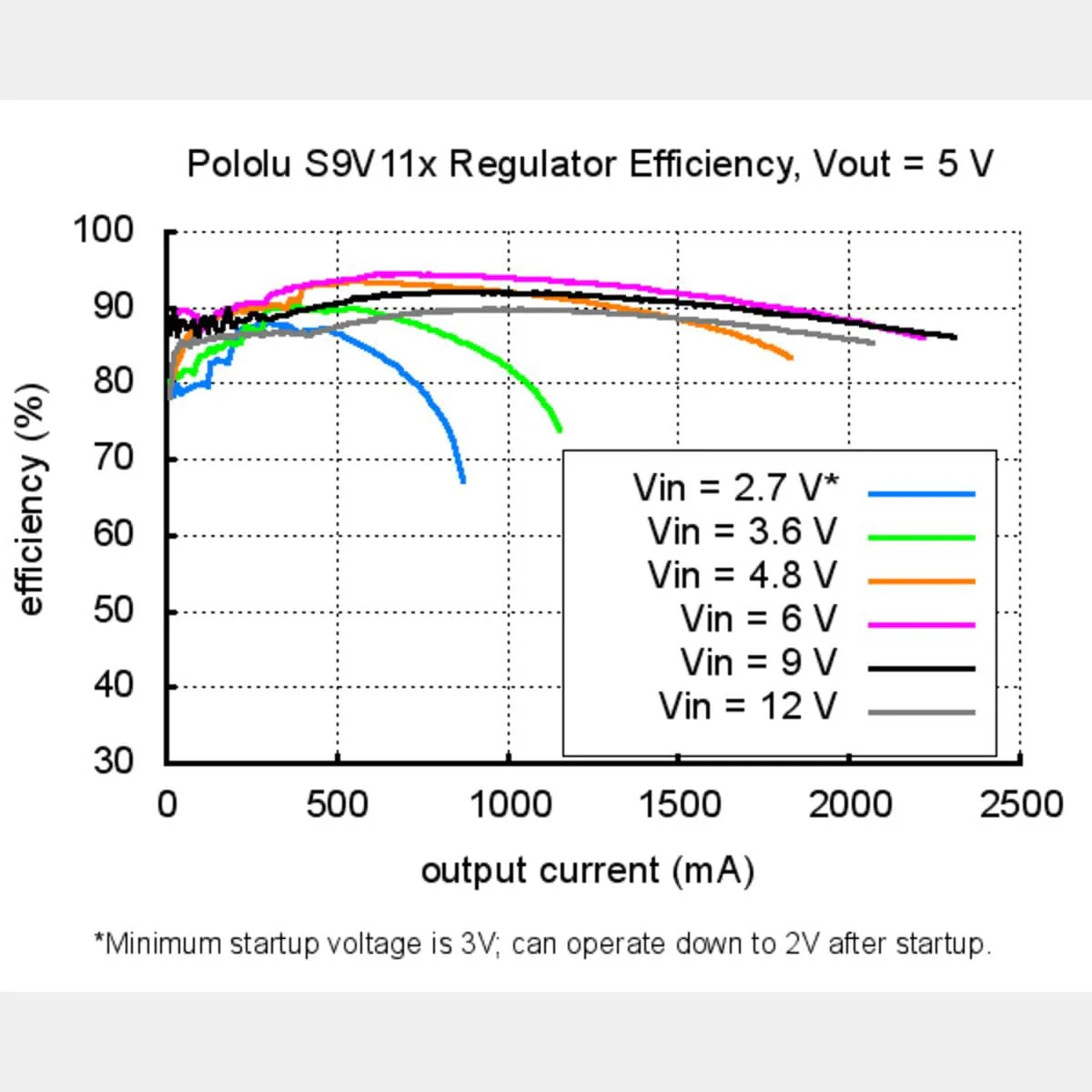
The efficiency of a voltage regulator, defined as (Power out)/(Power in), is an important measure of its performance, especially when battery life or heat are concerns. As shown in the graphs within the product images, this family of switching regulators typically has an efficiency of 85% to 95%. A power-saving feature maintains these high efficiencies even when the regulator current is very low.
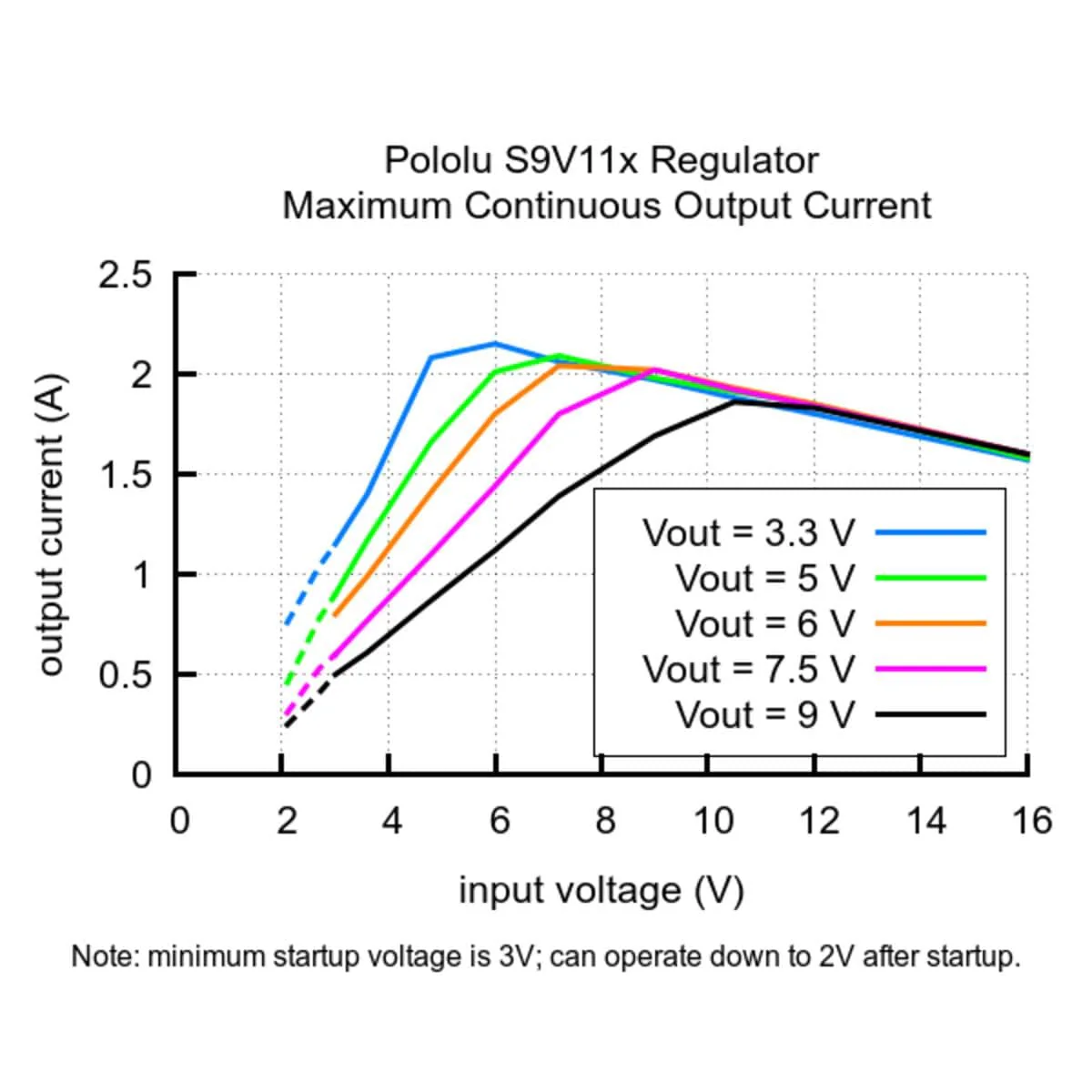
The maximum achievable output current of these regulators varies with the input voltage but also depends on other factors, including the ambient temperature, airflow, and heat sinking. The graph in the product images shows maximum output currents that these regulators can deliver continuously at room temperature in still air and without additional heat sinking. Depending on the input and output voltage, these regulators can temporarily deliver over 2 A, though they will typically quickly overheat under such conditions and go into thermal shutdown.
Note that the startup current for input voltages above the regulated output voltage is limited to approximately 700 mA, and currents in excess of this are only available after the output has finished stabilizing.
For input voltages below the output voltage, the available start-up current decreases linearly with the input voltage to approximately 0.3 A with an input of 3 V. Large capacitive loads will generally not pose a problem because they will gradually charge up even with the current limit active, so while they may increase the time it takes an S9V11x family regulator to start up, the regulator should still eventually stabilize.
A purely resistive load, however, could prevent the regulator from ever reaching the desired output voltage. For example, if the output of the regulator is 5V and you put a 5 Ω resistor between VOUT and GND and then apply power to the regulator, the output voltage will never rise past 3.5 V, the voltage at which the current draw reaches the 700 mA limit. As such, this family of regulators is intended for applications like robotics, where any large loads are controllable and can be applied only after the regulator has finished starting up.
LC Voltage Spikes
When connecting voltage to electronic circuits, the initial rush of current can cause voltage spikes that are much higher than the input voltage. If these spikes exceed a regulator’s maximum voltage, the regulator can be destroyed.
If you are connecting more than about 9V, using power leads more than a few inches long, or using a power supply with high inductance, we recommend soldering a 33 μF or larger electrolytic capacitor close to the regulator between VIN and GND. The capacitor should be rated for at least 20V.
Product Information
Product Information
Shipping & Returns
Shipping & Returns
Pololu 3.3V Step-Up/Down Voltage Regulator with Adjustable Low-Voltage Cut-off
Pololu 3.3V Step-Up/Down Voltage Regulator with Adjustable Low-Voltage Cut-off
The Pololu S9V11F3S5CMA switching step-up/step-down regulator efficiently produces a fixed 3.3V (default) or 5V (selectable) output whether it is higher or lower than the input voltage which can range from 2V to 16V (minimum start-up voltage is 3V, but it operates to 2V after that).
The regulator also has a precision-adjustable low-voltage cutoff with hysteresis that can be used to prevent battery over-discharge. The compact (12.7 × 15.3 × 6.4 mm) module can supply a typical output current of up to 1.5A when the input voltage is close to the output voltage.
Note: During normal operation, this product can get hot enough to burn you. Take care when handling this product or other components connected to it.
The S9V11x Family
The S9V11x family of efficient switching regulators (also called switched-mode power supplies (SMPS) or DC-to-DC converters) use a buck-boost topology to convert both higher and lower input voltages to a regulated output voltage.
They take input voltages from 2 V to 16 V and increase or decrease them as necessary, offering a typical efficiency of over 85% and a typical output current of up to 1.5 A. The flexibility in input voltage offered by this family of regulators is especially well-suited for battery-powered applications in which the battery voltage begins above the regulated voltage and drops below as the battery discharges. Without the typical restriction on the battery voltage staying above the required voltage throughout its life, new battery packs and form factors can be considered.
The different members of this family offer different output voltage options, from fixed voltages with selectable alternatives to adjustable voltages that can be set anywhere between 2.5 V and 9 V using a precision 12-turn potentiometer. Some versions also have an adjustable low-voltage cutoff that can be set anywhere in the 2 V to 16 V output voltage range and used to prevent your battery from over-discharging. This is particularly useful for battery chemistries that can be damaged when over-discharged, including Li-ion and LiPo.
These regulators have short-circuit protection, and thermal shutdown prevents damage from overheating; they do not have reverse-voltage protection. Note that the startup current is limited to approximately 700 mA until the output voltage reaches the nominal voltage; after startup, the available current is a function of the input voltage (see the Typical efficiency and output current section below).
Features
- Input voltage: 2 V to 16 V (note: this regulator requires 3 V to start, but it can operate down to 2 V after startup)
- Fixed 3.3V output with +5/-3% accuracy (can be changed to 5 V using the SEL pin)
- Typical maximum continuous output current: 1.5 A (when input voltage is close to the output; the Typical efficiency and output current section below shows how the achievable continuous output current depends on the input and output voltages)
- Precision-adjustable low-voltage cutoff with hysteresis can be used to protect batteries from over-discharging (quiescent current is approximately 10 µA per volt on VIN when the regulator is disabled)
- Power-good indicator can be used to tell when the regulator has reached and is maintaining its target output voltage
- Power-saving feature maintains high efficiency at low currents (quiescent current is less than 1 mA while enabled)
- Integrated over-temperature and short-circuit protection
- Small size: 12.7 × 15.3 × 6.4 mm
Specifications
| Minimum operating voltage | 2 V |
| Maximum operating voltage | 16 V |
| Maximum output current | 1.5 A |
| Output voltage | 3.3 V |
| Reverse voltage protection? | N |
| Maximum quiescent current | 1 mA |
| Low-voltage cutoff | Adjustable |
| Size | 12.7×15.3×6.4mm |
| Weight | 0.8g |
Included hardware
The five main through-holes are arranged with a 0.1″ spacing along the edge of the board for compatibility with standard solderless breadboards, perfboards and connectors that use a 0.1″ grid.
You can solder wires directly to the board or solder in pieces of the included breakaway 6×1 straight male header strip or the 5×1 right-angle male header strip as desired. The additional straight male header pin can be soldered into the SEL input, though this could prevent the regulator from being used in a breadboard.
Resources
- Dimension Diagram
- 3D Model (STEP)
- DXF Drill Guild
Connections
The step-up/step-down regulator has five main connections all located along the same edge of the board: the output voltage (OUT), ground (GND), the input voltage (IN), an enable input (EN), and a power good indicator (PG). A sixth pin, SEL, can optionally be used to change the output voltage from 3.3 V to 5 V.
The output voltage, VOUT, defaults to 3.3 V but can be changed to 5 V with output voltage selection pin whose operation is described below.
The input voltage, VIN, should be between 3 V and 16 V when the regulator is first powered. After it is running, it can continue operating down to 2 V. Lower inputs can shut down the voltage regulator; higher inputs can destroy the regulator, so you should ensure that noise on your input is not excessive, and you should be wary of destructive LC spikes (see below for more information).
The regulator features an enable pin, EN, that can be used as a precision low-voltage cutoff thanks to its tight activation and deactivation thresholds (voltages below 0.7 V trigger a low-power sleep state, and voltages above 0.8 V re-enable the regulator). On this regulator version, EN is connected to VIN through a 12-turn potentiometer to provide a user-adjustable cutoff threshold, which is useful for battery-powered applications where draining the battery below a particular voltage threshold could permanently damage it. The quiescent current draw in this sleep mode is dominated by the current in the resistor network from ENABLE to VIN, which is approximately 7 µA per volt on VIN (e.g. approximately 20 µA with 3 V in). See the Setting the cutoff voltage section below for details on how to use the built-in potentiometer to set the cutoff threshold.
The “power good” indicator, PG, is an open-drain output that goes low when the regulator’s output falls below around 90% of the nominal voltage, including when the enable pin is held low. The power good indicator is held low until the output reaches 95% of the nominal voltage when it is powering up or coming out of low-power mode. Otherwise, the PG pin is high-impedance, so an external pull-up resistor is required to use this pin.
The select input, SEL, can be driven above 1.1 V (up to 16 V) to change the output voltage of the regulator to 5 V. Driving the pin low or leaving it disconnected sets the output to 3.3 V. To permanently set the output to 5 V, you can solder a piece of wire between SEL and the unpopulated pad next to it, which is pulled up to VIN.
Setting the cutoff voltage
The low VIN cutoff voltage of the regulator is controlled by adjusting the voltage at the EN pin with a 12-turn precision potentiometer.
When the voltage on the EN pin falls below 0.7 V the regulator is put in a low-power sleep state and when the voltage on EN rises back above 0.8 V the regulator is turned back on. Turning the potentiometer clockwise increases the low-voltage cutoff. The cutoff voltage can be set by measuring the voltage on the VIN and EN pins and using the potentiometer to adjust the voltage on EN according to the following equation:
For example, if you connect VIN to a battery that currently measures 3.7 V and you want to set the cutoff voltage to 3.0 V, the equation becomes:
Solving for EN yields approximately 0.86 V, so you should turn the potentiometer until you measure that voltage on the EN pin.
Note that the regulator’s low VIN cutoff behaviour includes hysteresis: the regulator turns off when EN falls below 0.7 V, but it does not turn back on until EN rises above 0.8 V. Therefore, VIN must reach about 114% of the cutoff voltage before the regulator will re-enable its output (about 3.43 V in this example).
Typical efficiency and output current
The efficiency of a voltage regulator, defined as (Power out)/(Power in), is an important measure of its performance, especially when battery life or heat are concerns. As shown in the graphs within the product images, this family of switching regulators typically has an efficiency of 85% to 95%. A power-saving feature maintains these high efficiencies even when the regulator current is very low.
The maximum achievable output current of these regulators varies with the input voltage but also depends on other factors, including the ambient temperature, airflow, and heat sinking. The graph in the product images shows maximum output currents that these regulators can deliver continuously at room temperature in still air and without additional heat sinking. Depending on the input and output voltage, these regulators can temporarily deliver over 2 A, though they will typically quickly overheat under such conditions and go into thermal shutdown.
Note that the startup current for input voltages above the regulated output voltage is limited to approximately 700 mA, and currents in excess of this are only available after the output has finished stabilizing.
For input voltages below the output voltage, the available start-up current decreases linearly with the input voltage to approximately 0.3 A with an input of 3 V. Large capacitive loads will generally not pose a problem because they will gradually charge up even with the current limit active, so while they may increase the time it takes an S9V11x family regulator to start up, the regulator should still eventually stabilize.
A purely resistive load, however, could prevent the regulator from ever reaching the desired output voltage. For example, if the output of the regulator is 5V and you put a 5 Ω resistor between VOUT and GND and then apply power to the regulator, the output voltage will never rise past 3.5 V, the voltage at which the current draw reaches the 700 mA limit. As such, this family of regulators is intended for applications like robotics, where any large loads are controllable and can be applied only after the regulator has finished starting up.
LC Voltage Spikes
When connecting voltage to electronic circuits, the initial rush of current can cause voltage spikes that are much higher than the input voltage. If these spikes exceed a regulator’s maximum voltage, the regulator can be destroyed.
If you are connecting more than about 9V, using power leads more than a few inches long, or using a power supply with high inductance, we recommend soldering a 33 μF or larger electrolytic capacitor close to the regulator between VIN and GND. The capacitor should be rated for at least 20V.
Original: $14.43
-70%$14.43
$4.33Product Information
Product Information
Shipping & Returns
Shipping & Returns
Description
The Pololu S9V11F3S5CMA switching step-up/step-down regulator efficiently produces a fixed 3.3V (default) or 5V (selectable) output whether it is higher or lower than the input voltage which can range from 2V to 16V (minimum start-up voltage is 3V, but it operates to 2V after that).
The regulator also has a precision-adjustable low-voltage cutoff with hysteresis that can be used to prevent battery over-discharge. The compact (12.7 × 15.3 × 6.4 mm) module can supply a typical output current of up to 1.5A when the input voltage is close to the output voltage.
Note: During normal operation, this product can get hot enough to burn you. Take care when handling this product or other components connected to it.
The S9V11x Family
The S9V11x family of efficient switching regulators (also called switched-mode power supplies (SMPS) or DC-to-DC converters) use a buck-boost topology to convert both higher and lower input voltages to a regulated output voltage.
They take input voltages from 2 V to 16 V and increase or decrease them as necessary, offering a typical efficiency of over 85% and a typical output current of up to 1.5 A. The flexibility in input voltage offered by this family of regulators is especially well-suited for battery-powered applications in which the battery voltage begins above the regulated voltage and drops below as the battery discharges. Without the typical restriction on the battery voltage staying above the required voltage throughout its life, new battery packs and form factors can be considered.
The different members of this family offer different output voltage options, from fixed voltages with selectable alternatives to adjustable voltages that can be set anywhere between 2.5 V and 9 V using a precision 12-turn potentiometer. Some versions also have an adjustable low-voltage cutoff that can be set anywhere in the 2 V to 16 V output voltage range and used to prevent your battery from over-discharging. This is particularly useful for battery chemistries that can be damaged when over-discharged, including Li-ion and LiPo.
These regulators have short-circuit protection, and thermal shutdown prevents damage from overheating; they do not have reverse-voltage protection. Note that the startup current is limited to approximately 700 mA until the output voltage reaches the nominal voltage; after startup, the available current is a function of the input voltage (see the Typical efficiency and output current section below).
Features
- Input voltage: 2 V to 16 V (note: this regulator requires 3 V to start, but it can operate down to 2 V after startup)
- Fixed 3.3V output with +5/-3% accuracy (can be changed to 5 V using the SEL pin)
- Typical maximum continuous output current: 1.5 A (when input voltage is close to the output; the Typical efficiency and output current section below shows how the achievable continuous output current depends on the input and output voltages)
- Precision-adjustable low-voltage cutoff with hysteresis can be used to protect batteries from over-discharging (quiescent current is approximately 10 µA per volt on VIN when the regulator is disabled)
- Power-good indicator can be used to tell when the regulator has reached and is maintaining its target output voltage
- Power-saving feature maintains high efficiency at low currents (quiescent current is less than 1 mA while enabled)
- Integrated over-temperature and short-circuit protection
- Small size: 12.7 × 15.3 × 6.4 mm
Specifications
| Minimum operating voltage | 2 V |
| Maximum operating voltage | 16 V |
| Maximum output current | 1.5 A |
| Output voltage | 3.3 V |
| Reverse voltage protection? | N |
| Maximum quiescent current | 1 mA |
| Low-voltage cutoff | Adjustable |
| Size | 12.7×15.3×6.4mm |
| Weight | 0.8g |
Included hardware
The five main through-holes are arranged with a 0.1″ spacing along the edge of the board for compatibility with standard solderless breadboards, perfboards and connectors that use a 0.1″ grid.
You can solder wires directly to the board or solder in pieces of the included breakaway 6×1 straight male header strip or the 5×1 right-angle male header strip as desired. The additional straight male header pin can be soldered into the SEL input, though this could prevent the regulator from being used in a breadboard.
Resources
- Dimension Diagram
- 3D Model (STEP)
- DXF Drill Guild
Connections
The step-up/step-down regulator has five main connections all located along the same edge of the board: the output voltage (OUT), ground (GND), the input voltage (IN), an enable input (EN), and a power good indicator (PG). A sixth pin, SEL, can optionally be used to change the output voltage from 3.3 V to 5 V.
The output voltage, VOUT, defaults to 3.3 V but can be changed to 5 V with output voltage selection pin whose operation is described below.
The input voltage, VIN, should be between 3 V and 16 V when the regulator is first powered. After it is running, it can continue operating down to 2 V. Lower inputs can shut down the voltage regulator; higher inputs can destroy the regulator, so you should ensure that noise on your input is not excessive, and you should be wary of destructive LC spikes (see below for more information).
The regulator features an enable pin, EN, that can be used as a precision low-voltage cutoff thanks to its tight activation and deactivation thresholds (voltages below 0.7 V trigger a low-power sleep state, and voltages above 0.8 V re-enable the regulator). On this regulator version, EN is connected to VIN through a 12-turn potentiometer to provide a user-adjustable cutoff threshold, which is useful for battery-powered applications where draining the battery below a particular voltage threshold could permanently damage it. The quiescent current draw in this sleep mode is dominated by the current in the resistor network from ENABLE to VIN, which is approximately 7 µA per volt on VIN (e.g. approximately 20 µA with 3 V in). See the Setting the cutoff voltage section below for details on how to use the built-in potentiometer to set the cutoff threshold.
The “power good” indicator, PG, is an open-drain output that goes low when the regulator’s output falls below around 90% of the nominal voltage, including when the enable pin is held low. The power good indicator is held low until the output reaches 95% of the nominal voltage when it is powering up or coming out of low-power mode. Otherwise, the PG pin is high-impedance, so an external pull-up resistor is required to use this pin.
The select input, SEL, can be driven above 1.1 V (up to 16 V) to change the output voltage of the regulator to 5 V. Driving the pin low or leaving it disconnected sets the output to 3.3 V. To permanently set the output to 5 V, you can solder a piece of wire between SEL and the unpopulated pad next to it, which is pulled up to VIN.
Setting the cutoff voltage
The low VIN cutoff voltage of the regulator is controlled by adjusting the voltage at the EN pin with a 12-turn precision potentiometer.
When the voltage on the EN pin falls below 0.7 V the regulator is put in a low-power sleep state and when the voltage on EN rises back above 0.8 V the regulator is turned back on. Turning the potentiometer clockwise increases the low-voltage cutoff. The cutoff voltage can be set by measuring the voltage on the VIN and EN pins and using the potentiometer to adjust the voltage on EN according to the following equation:
For example, if you connect VIN to a battery that currently measures 3.7 V and you want to set the cutoff voltage to 3.0 V, the equation becomes:
Solving for EN yields approximately 0.86 V, so you should turn the potentiometer until you measure that voltage on the EN pin.
Note that the regulator’s low VIN cutoff behaviour includes hysteresis: the regulator turns off when EN falls below 0.7 V, but it does not turn back on until EN rises above 0.8 V. Therefore, VIN must reach about 114% of the cutoff voltage before the regulator will re-enable its output (about 3.43 V in this example).
Typical efficiency and output current
The efficiency of a voltage regulator, defined as (Power out)/(Power in), is an important measure of its performance, especially when battery life or heat are concerns. As shown in the graphs within the product images, this family of switching regulators typically has an efficiency of 85% to 95%. A power-saving feature maintains these high efficiencies even when the regulator current is very low.
The maximum achievable output current of these regulators varies with the input voltage but also depends on other factors, including the ambient temperature, airflow, and heat sinking. The graph in the product images shows maximum output currents that these regulators can deliver continuously at room temperature in still air and without additional heat sinking. Depending on the input and output voltage, these regulators can temporarily deliver over 2 A, though they will typically quickly overheat under such conditions and go into thermal shutdown.
Note that the startup current for input voltages above the regulated output voltage is limited to approximately 700 mA, and currents in excess of this are only available after the output has finished stabilizing.
For input voltages below the output voltage, the available start-up current decreases linearly with the input voltage to approximately 0.3 A with an input of 3 V. Large capacitive loads will generally not pose a problem because they will gradually charge up even with the current limit active, so while they may increase the time it takes an S9V11x family regulator to start up, the regulator should still eventually stabilize.
A purely resistive load, however, could prevent the regulator from ever reaching the desired output voltage. For example, if the output of the regulator is 5V and you put a 5 Ω resistor between VOUT and GND and then apply power to the regulator, the output voltage will never rise past 3.5 V, the voltage at which the current draw reaches the 700 mA limit. As such, this family of regulators is intended for applications like robotics, where any large loads are controllable and can be applied only after the regulator has finished starting up.
LC Voltage Spikes
When connecting voltage to electronic circuits, the initial rush of current can cause voltage spikes that are much higher than the input voltage. If these spikes exceed a regulator’s maximum voltage, the regulator can be destroyed.
If you are connecting more than about 9V, using power leads more than a few inches long, or using a power supply with high inductance, we recommend soldering a 33 μF or larger electrolytic capacitor close to the regulator between VIN and GND. The capacitor should be rated for at least 20V.